
A hyperscaler, like AWS, Microsoft Azure or Google Cloud, rents you the computers, storage and network your product runs on. A managed cloud service provider sets up, watches, secures and fixes what you build on top of that. You always need a hyperscaler (or another host). You need a managed provider when nobody on your team has the time or skills to run your cloud properly.
Most founders assume AWS “handles” their cloud because they pay AWS. AWS is clear that it doesn’t, and knowing where its job stops is the whole decision
A hyperscaler is a cloud provider big enough to offer computing power on demand, almost anywhere in the world. Three companies dominate. In the second quarter of 2026, Synergy Research Group put Amazon at 28% of the cloud infrastructure market, Microsoft at 20% and Google at 15%, in a market worth $143.4 billion that quarter.
You pay a hyperscaler for what you use. In return, you get raw building blocks: servers, databases, storage and networking.
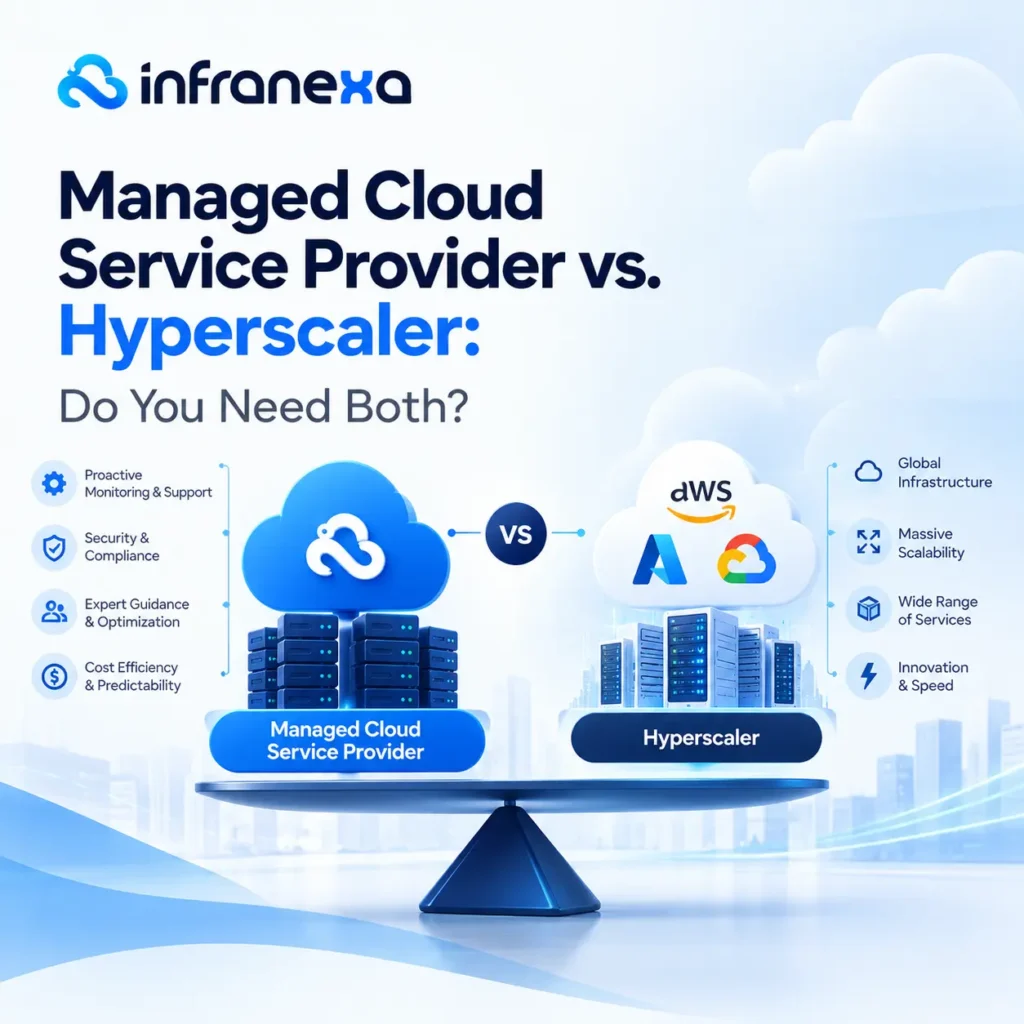
AWS explains this in its shared responsibility model. AWS is responsible for “security of the cloud”: the data centers, hardware and core network. You are responsible for “security in the cloud”.
For a typical startup running on AWS servers, AWS says your side includes the operating system updates and security patches, the software you install, and the firewall settings. For storage and databases, it includes your data, encryption choices and who has access.
In plain terms, AWS keeps the building standing. What happens inside your space is yours to manage:
AWS sells support plans, and they help. But they’re help desks, not operators. They answer your team’s questions and help when something breaks. They don’t run your setup day to day.
They’re also priced on your spend. On AWS’s support pricing page, Business Support+ starts at $29 a month or 9% of your monthly AWS charges up to $10,000, whichever is greater. Enterprise Support starts at $5,000 a month.
A managed provider takes on the “in the cloud” work your team would otherwise do. That usually includes:
Most charge a fixed monthly fee, which makes the cost of running your cloud predictable even when your usage isn’t.
| Hyperscaler (AWS, Azure, Google Cloud) |
Managed cloud service provider |
|
|---|---|---|
| What you get | Computing power, storage, network | People and processes that run it |
| Who’s responsible for your setup | You | The provider, as agreed in contract |
| How you pay | For what you use | Usually a fixed monthly fee |
| When something breaks at night | Your team responds | The provider responds |
| Replaces the other? | No | No, it runs on top of a hyperscaler |
You always need the hyperscaler. The question is who runs it.
You probably don’t need a managed provider if you have an experienced DevOps or cloud engineer in-house with time to spare, your setup is simple, and an outage for a few hours wouldn’t hurt customers much.
You probably do if:
That last one is more common than it sounds. Many startups run on a setup only one person understands.
The alternative to a managed provider is hiring. A full-time cloud or DevOps engineer is a senior hire in the US, and one person can’t cover nights, weekends and holidays alone. Compare the full cost of that hire, including the time it takes to recruit, with a managed provider’s fixed fee before deciding.
Cloud waste is also worth weighing. Flexera’s 2026 State of the Cloud report put wasted cloud spend at 29%, rising for the first time in five years. Someone has to be watching the bill for that to go down.
Infranexa is a managed cloud and DevOps provider for startups on AWS and Azure. We handle setup, monitoring, security, deployments and cost control on a fixed monthly fee, so your team can stay focused on the product.
If you’re not sure which side of the line your cloud work falls on, book a free cloud assessment. We’ll go through your setup and tell you what needs attention first.
No. AWS is a hyperscaler. It offers some managed services, like managed databases, but you’re still responsible for how you set up and run your environment.
Many do. Infranexa works across AWS and Azure.
You shouldn’t. Your accounts and data should stay in your name, with the provider given access. Ask any provider to confirm this before you sign.